
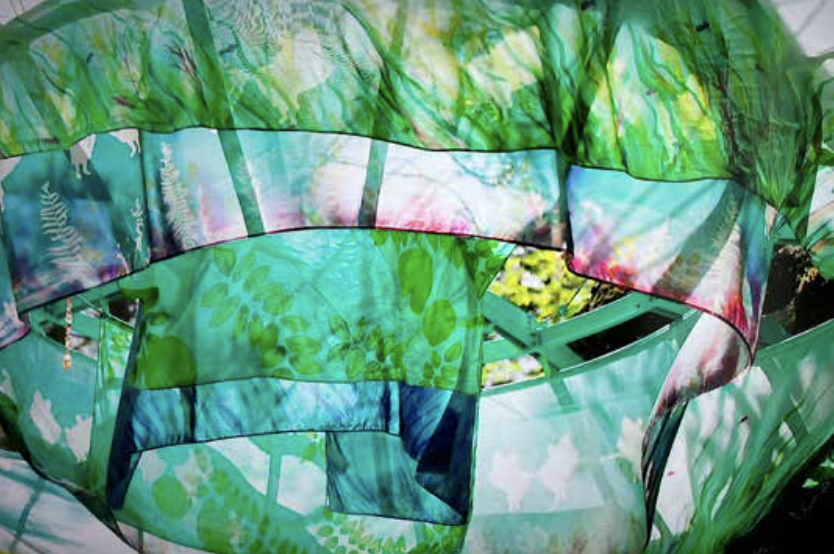
“The Land Tells Our Stories” is an ambitious group of three large scale, site-specific works which unfurl across Massachusetts this summer. The project has been commissioned by the Trustees of Reservations at four of its properties, some well-known and some off the beaten path: the Crane Estate and Beach in Ipswich, Moose Hill Farm in Sharon, Rock House Reservation in West Brookfield and Fruitlands Museum in Harvard, Massachusetts.
The Crane Estate, a palatial North Shore summer home built in the 1920s for a wealthy industrialist, is now a Trustees-managed, National Historic Landmark. The estate and its accompanying beach are the settings for Posey (Pamela) Moulton’s sculpture, “Second Wind.” Constructed as an arch framing both the land and the ocean, the large-scale piece uses Pal Tiya cement over a stainless-steel framework, which is festooned with casts of seashells and textured like the tidal wrack which inspires the artist. “Second Wind” also incorporates the detritus of ghost fishing gear — ropes, traps, fishing line — Moulton finds on New England beaches near her Maine home. The whimsical arch, colored pink, red and white, accents both the famous Crane’s Beach and the stately home, its lacy structure referencing tides and the growth of marine organisms.
In Sharon, Mass., at Moose Hill Farm, May Babcock explores themes of species extinction, environmental destruction and climate change — all consequences of human activity. Babcock’s installation, “Seaside Chestnuts,” serves practical and symbolic purposes. The artist uses farm fencing coated with a colorful, flax-based paper pulp, to create protective structures encircling 11 young chestnut trees specially planted, with the American Chestnut Foundation, for her exhibit. The classic New England farm is not near the coast, but the artist points out that, if global warming increases to the point of melting the polar ice caps, the inland town of Sharon will be a coastal area by 2100. Symbolic of Babcock’s Taiwanese-Chinese heritage, the artist selected both native American chestnut saplings and Asian-American hybrids, newly bred to withstand the near-extinction of American chestnut trees by an introduced fungus in the early 20th century. Babcock’s work is both hopeful and dire, rescuing survivors of one species but realizing their fragile home may be inundated by the ocean.